
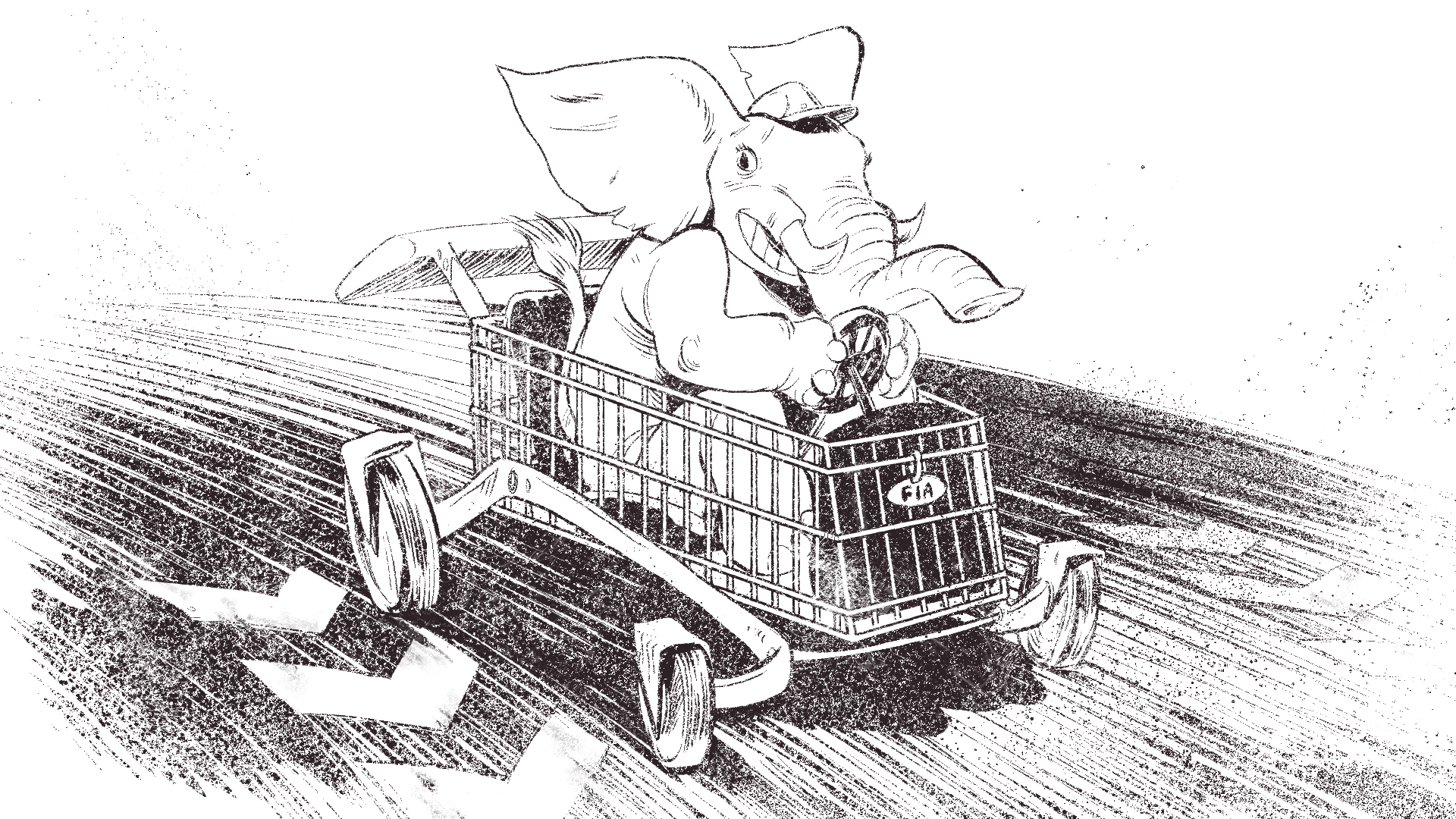
Frits van Eerd’s fall from the top of Dutch retail
The former Jumbo boss turned a provincial family business into a supermarket giant. His conviction for bribery, forgery and money-laundering exposed the risks of mixing personal ambition with corporate power.
In the world of supermarkets, success is usually measured in fractions of a percentage point. Margins are thin, customers are fickle and even the most carefully planned expansion can be undone by a price war. Frits van Eerd, the former boss of Jumbo, the Dutch supermarket chain, preferred to think bigger. He built his family’s business into one of the Netherlands’ largest grocery retailers, acquired rivals whilst pursuing a second career in motor racing. His appetite for risk was an asset, until it wasn’t.
On August 7th 2025, a court in Groningen sentenced Mr van Eerd to two years in prison after finding him guilty of accepting bribes, forgery and money-laundering. The judgment marked a spectacular reversal for a man who had once embodied the commercial ambitions of a family-owned business. It also raised an awkward question about the relationship between entrepreneurial success and accountability: how much should a company depend on the judgment of one powerful individual?
NOS, August 2025.
A family business with grand ambitions
Born in 1967, Mr van Eerd joined Jumbo in 1992, after studying business administration in Utrecht and America. The company had been founded by his father, Karel van Eerd, and was rooted in Veghel, a town in the southern Dutch province of North Brabant. Mr van Eerd began in the bread department before moving into supermarket management. By 2002 he was the company’s general manager.
His achievement was to recognise that Jumbo could not grow into a national contender simply by opening stores one at a time. It would need to buy its way into a crowded market. In 2009 Jumbo acquired Super de Boer, a much larger rival, in a deal worth roughly €550m. In 2012 it took over C1000, another substantial supermarket chain. The acquisitions transformed Jumbo from a regional operator into the Netherlands’ second-largest supermarket business, behind Albert Heijn.
NRC, November 2009; NOS, March 2023.
The strategy was bold, but it was not merely a matter of signing cheques. Combining retail chains means reconciling different distribution networks, store formats, suppliers and corporate cultures. Jumbo spent years integrating the businesses it had bought, eventually converting hundreds of former Super de Boer and C1000 outlets to its own brand. The company’s expansion demonstrated that a family firm could compete with larger, established rivals through a mixture of aggressive deal-making and operational discipline. Jumbo.
Mr van Eerd was well suited to the public image of the daring entrepreneur. He was a motor racer, a sport that rewards confidence, competitive instinct and a high tolerance for danger and risk. He began racing in Formula Renault in the 1990s and later founded Racing Team Nederland. In 2021 the team won the LMP2 Pro/Am drivers’ and teams’ titles in the FIA World Endurance Championship, with Mr van Eerd taking the drivers’ crown. FIA, November 2021.
The racing was more than a hobby for this wealthy businessman. It reinforced the image of a man who wanted to compete on his own terms, whether in the supermarket aisle or on the track. But there is a difference between risk-taking in sport, where rules are explicit and penalties visible, and risk-taking in business, where the consequences can be borne by employees, suppliers and shareholders.
Cold hard cash – in the refrigerator
The unravelling began in September 2022, when the Dutch Fiscal Information and Investigation Service, known as the FIOD, raided Mr van Eerd’s home and Jumbo’s headquarters. Investigators found roughly €450,000 in cash at his home, some of it concealed in a refrigerator. The investigation centred on his dealings with a car trader suspected of involvement in criminal activity. NOS, August 2025.
Mr van Eerd stepped down as Jumbo’s chief executive that month, initially describing his departure as temporary while he dealt with the investigation. In March 2023, however, the company confirmed that he would not return. Ton van Veen, who had taken over on an interim basis, became chairman of the board. The change ended the Van Eerd family’s direct hold on Jumbo’s executive leadership, though Frits remained a shareholder. Jumbo, September 2022; NOS, March 2023.
The case went to trial in September 2024. In August 2025 the court found Mr van Eerd guilty of accepting bribes, forgery and money-laundering, and imposed an unconditional two-year prison sentence. According to the court’s findings, the cash was linked to payments received over several years from the car trader, and Mr van Eerd knew that substantial sums originated in criminal activity. His lawyer indicated that an appeal was likely, so the distinction between a trial-court conviction and the final outcome of any appeal matters. NOS, August 2025; RTL Z, August 2025.
The contrast with Mr van Eerd’s earlier career is stark. The man who had built a national retail champion was convicted of conduct that undermined the basic trust on which a business depends. Money-laundering is not simply a technical financial offence. It allows proceeds from criminal activity to circulate through apparently legitimate transactions, obscuring their origin. Bribery and false documentation further corrode the reliability of commercial relationships.
The limits of the founder’s instinct
Jumbo’s predicament illustrates a familiar problem in family capitalism. Family ownership can confer patience, a long investment horizon and a strong sense of identity. It can also blur the boundaries between the interests of the business and those of its owners. When the person who embodies the company’s story also wields considerable influence over it, independent scrutiny becomes particularly important.
There is no reason to conclude that Jumbo’s growth was itself tainted by the offences for which Mr van Eerd was convicted. Its acquisitions and integration programme were substantial commercial achievements, and the company continued under new leadership after his departure. But the case shows how a leader’s personal conduct can overshadow years of corporate progress.
The change of chief executive was therefore more than a succession issue. It was a test of whether Jumbo could operate as an institution rather than as an extension of the family that built it. The appointment of Mr van Veen gave the company a leader who had long been involved in its financial and operational development. It also offered a chance to separate the business’s future from the fate of its former boss.
NOS, March 2023.
For Mr van Eerd, the irony is difficult to miss. He spent decades proving that Jumbo could overtake larger rivals by taking risks that more cautious competitors avoided. His motor-racing career supplied a vivid metaphor for that ambition: accelerate, find a line and try to win. Yet commercial leadership demands a different discipline from racing. A driver may gamble with his own position; a chief executive is a custodian of other people’s livelihoods, capital and trust.
Jumbo’s rise remains part of his legacy. So does the conviction that brought his executive career to an end. The first demonstrated the power of ambition; the second, the cost of failing to respect the ‘track limits’. References
- NOS, 7 August 2025 — Former Jumbo boss Van Eerd sentenced to two years in prison.
- NOS, 7 March 2023 — Frits van Eerd definitively leaves Jumbo.
- NRC, 2 November 2009 — The daring Frits van Eerd has gone beyond his limitations.
- Jumbo, 2015 — Jumbo completes its largest-ever store conversion
programme. - FIA, November 2021 — 2021 World Endurance Championship season finale.
- Jumbo, 23 September 2022 — Van Eerd steps down temporarily as managing director.
- RTL Z, 7 August 2025 — Court convicts former Jumbo boss.