
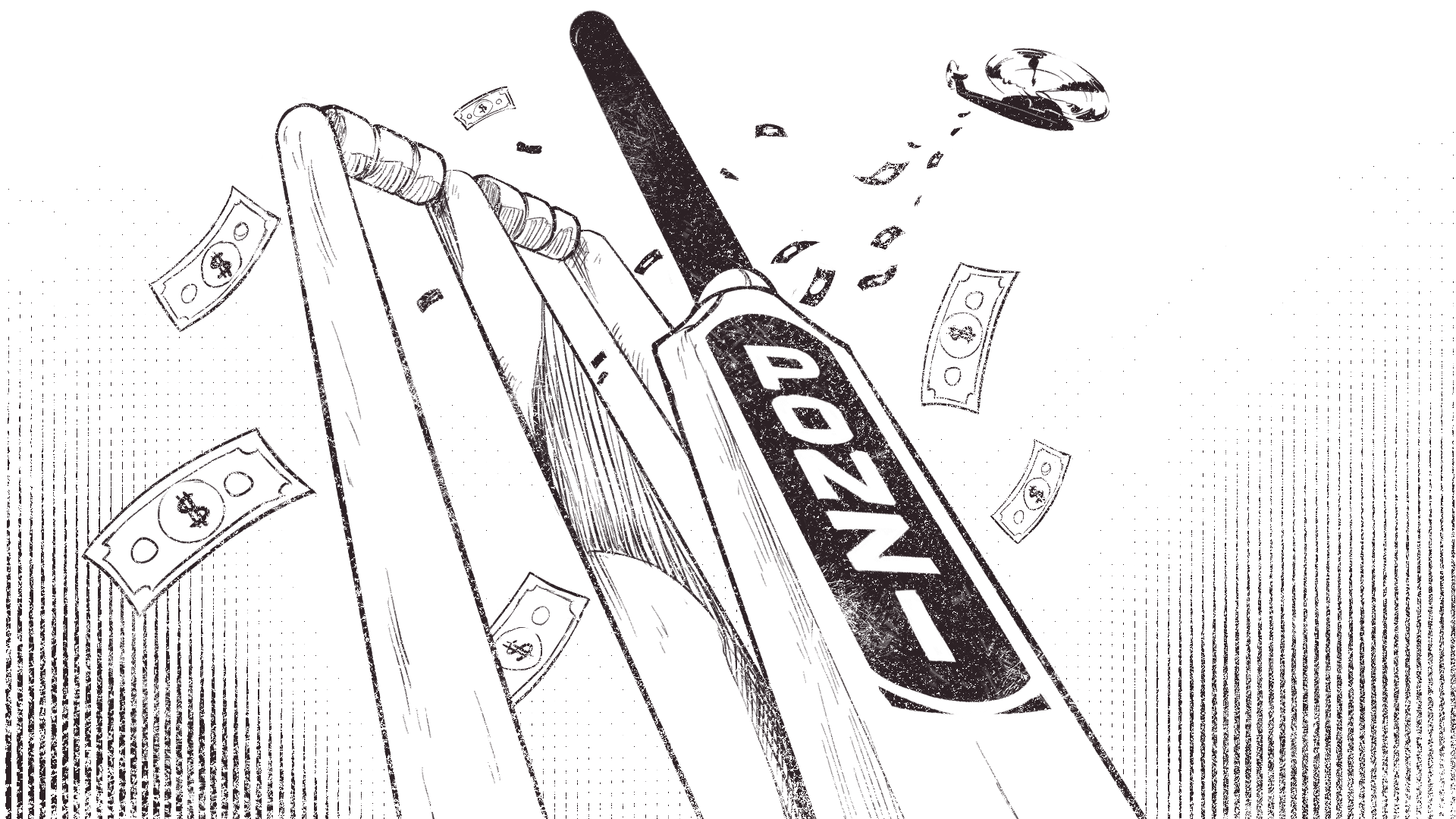
Allen Stanford promised to make cricket richer, faster and, above all, American. Instead he left behind one of the sport’s most embarrassing lessons about the dangers of confusing money with wealth.
There are few more revealing images of Allen Stanford’s brief reign over cricket than the one at Lord’s in June 2008. A black helicopter descended onto the pitch of the world’s most venerable cricket ground. From it emerged an enormous Texan with a large moustache and an even larger proposition. Behind him, in a Perspex box, were $20m in $50 notes.
The money was not metaphorical. Stanford wanted everyone to see it.
He was announcing a winner-takes-all Twenty20 match between England and a Caribbean all-star team. The winning side would divide $20m; each winning player would receive $1m. Four more such matches were contemplated, making $100m of prize money. Stanford was also discussing a tournament in England and a Twenty20 league intended to compete with the Indian Premier League (IPL). (The Guardian)
At the time it looked less like a financial scheme than a revolution. Cricket, a game that had spent centuries perfecting the art of making money seem vulgar, had discovered a Texan willing to throw it around like confetti.
The joke, eventually, was that the confetti belonged to other people.
A billionaire with a plan to knock ‘em for six
R. Allen Stanford was not an obvious cricket revolutionary. Born in Texas and educated at Baylor University, he made his early fortune in distressed Houston real estate before turning the family insurance business into Stanford Financial Group, an international financial-services empire. By 2008 Forbes estimated his fortune at $2.2bn. He lived between the Caribbean and the United States, owned yachts and aircraft, and had become a substantial figure in Antigua, where he built a cricket stadium and employed large numbers of people. (Forbes)
He discovered cricket after spending years in the Caribbean. What attracted him was not its traditional Englishness but its commercial potential. Twenty20, the abbreviated form of the game introduced in England in 2003, could be finished in roughly three hours. That made it considerably easier to sell to television viewers than a five-day Test match and, Stanford thought, potentially easier to sell to Americans. (Forbes)
He began with the Stanford 20/20 tournament in the Caribbean, offering unusually large prizes to domestic teams. Stanford reportedly committed $28m a year to the competition. In a region where cricket administrations were chronically short of money, this was not merely sponsorship. It was patronage on a colonial scale, except that the patron was from Texas. (Forbes)
Stanford’s ambitions quickly expanded. He wanted cricket to become a global entertainment business, with the Caribbean as its centre and the United States as its next, lucrative frontier. He even spent $3.5m testing whether residents of Fort Collins, Colorado, could be persuaded to watch cricket on television. The results were hardly a clear boundary: 6% of those surveyed said they would consider paying to watch it. (Forbes)
But Stanford had found the perfect moment for his sales pitch.
The IPL had just demonstrated that Twenty20 could turn cricketers into highly paid entertainers. English players wanted access to India’s new riches. Caribbean cricket was struggling financially. And administrators in England feared that the IPL would become so powerful that it could dictate the international game’s economics.
Stanford offered an alternative source of money.
He was not merely selling cricket. He was selling himself as cricket’s alternative banker.
The ECB takes the cheque
The England and Wales Cricket Board (ECB) was receptive. In June 2008 Stanford and the ECB announced their agreement at Lord’s. The centrepiece was the $20m match in Antigua, but the relationship was supposed to extend much further. Stanford was expected to invest roughly $100m in cricket over five years. (The Guardian)
The arrangement made a certain commercial sense. England wanted to keep its best players from being lured away by overseas Twenty20 competitions. The West Indies needed investment. Stanford appeared to possess plenty of it. And Twenty20 was growing too quickly for cricket’s dusty old administrators to pretend that the traditional economics would survive unchanged.
There was, however, an awkward question: why was a private financier suddenly in a position to determine the future of an international sport?
The answer, in retrospect, was uncomfortable. Cricket’s institutions wanted the money because they believed Stanford had the money. They even saw it in a big plastic box on the hallowed ground of Lord’s.
The distinction would prove important.
The main event took place on November 1st 2008. England faced Stanford’s Caribbean Superstars at his purpose-built ground in Antigua. The winner would collect $20m; the loser would get nothing. The winning players were each promised $1m, with further sums for reserves and management. The remaining prize money was to be divided between the ECB and the West Indies Cricket Board (WICB). (Mail & Guardian)
For three hours, Stanford appeared to have achieved something remarkable. He had persuaded the guardians of one of the world’s oldest sports to participate in a spectacle designed around his money, his stadium and his team.
The cricket itself was almost incidental.
The Superstars, captained by Chris Gayle, demolished England. The Caribbean side won comfortably, collecting the $20m. Stanford had staged the richest single match in team sport and his own team had won it. (Forbes)
It was a spectacular success.
It was also to be his last.
The money problem old chap
In February 2009 American regulators accused Stanford and his companies of operating an enormous fraud centred on Stanford International Bank in Antigua. The Securities and Exchange Commission alleged that roughly $8bn had been raised through certificates of deposit sold to investors, with false claims about the safety and performance of the underlying investments. (SEC)
The allegations transformed the cricket story overnight.
The man who had appeared to have an almost inexhaustible supply of money suddenly appeared to have been financing his empire with money that was not, in the relevant sense, his.
The ECB and WICB suspended their dealings with Stanford. A proposed international tournament in England disappeared. Plans for further $20m matches disappeared with it. A proposed English Twenty20 league, conceived partly as a rival to the IPL, never got off the ground. (Forbes)
The sums involved in cricket were tiny compared with the alleged fraud. That was precisely the problem. The $20m prize fund, the cricket sponsorships and Stanford’s lavish sporting activities were not the centre of the scandal. They were symptoms of the same extraordinary confidence that had persuaded investors to entrust billions to his institutions.
The SEC later described the scheme as an $8bn Ponzi scheme. In 2012 a federal jury convicted Stanford on 13 of 14 counts. He was sentenced to 110 years in prison and ordered to pay a $5.9bn money judgment. (Department of Justice)
In January 2025 the long-running SEC civil case finally reached judgment. A federal judge imposed a $5.9bn civil penalty on Stanford; the SEC said that billions of dollars had been recovered for victims through forfeiture and related proceedings. (SEC)
The cricket money, in other words, had been a very small over of a very large innings.
Cricket’s lesson
The Stanford affair is sometimes remembered merely as an amusing scandal: the Texan billionaire, the helicopter at Lord’s, the cash in the Perspex box, the players suddenly becoming millionaires.
That is too easy.
Stanford exposed something more consequential about modern cricket. The sport had become dependent on people who could turn attention into money, and on institutions willing to accept the money before asking too many questions about where it came from.
The ECB was not alone in being impressed. Stanford had become a major benefactor of West Indian cricket and had invested heavily in Antigua. He was not presenting himself as a mysterious stranger with a suitcase of cash. He had constructed a substantial business, cultivated political relationships and surrounded himself with the conventional paraphernalia of legitimacy. Forbes itself profiled him in 2008 as a billionaire businessman with a $2bn-revenue financial company. (Forbes)
That made the failure of due diligence more instructive, not less.
Giles Clarke, then chairman of the ECB, subsequently acknowledged that the board might have made an error of judgment in becoming involved with Stanford, while insisting that it had acted with good intentions. (Forbes)
The deeper mistake was perhaps conceptual. Cricket’s administrators had treated Stanford as an investor when what they really had was a sponsor and a sponsor whose personal wealth and corporate finances were unusually difficult to separate.
A healthy sports economy requires investors who expect a return, sponsors who expect publicity and philanthropists who expect little more than gratitude. Stanford blurred the lines of all three categories. He wanted cricket to grow, but he also wanted cricket to carry his name. He wanted television audiences, but also a commercial platform. He wanted influence, and he had the money, or appeared to have it, to obtain it.
The result was a peculiar kind of private government.
For a few months in 2008, Allen Stanford seemed capable of doing something that generations of cricket administrators had failed to do: making the sport move at the speed of money.
Then the money stopped.
The man who bought the wrong thing
Stanford did not, strictly speaking, buy cricket. No individual could. The game’s governing bodies remained in charge, and its great institutions survived him.
But for a short period he bought something almost as valuable: cricket’s attention.
He persuaded England to fly to Antigua for a $20m game. He put millions into Caribbean cricket. He contemplated a rival to the IPL. He made administrators think that one extraordinarily rich American could solve problems that decades of governance had failed to solve.
The irony is that his biggest contribution to cricket may have been unintended.
His collapse helped establish a useful rule for the era of franchise sports: money is not the same thing as capital.
Money can pay a player. Capital builds a league. Money can buy a stadium. Capital sustains it. Money can fund one spectacular match. Capital pays for the tenth season.
Stanford had money. Or, at least, he appeared to.
What he did not possess was the thing cricket had briefly mistaken it for: a sustainable source of wealth.
The Stanford Super Series lasted one year. The proposed $100m programme lasted one match. The man who promised to make cricket an American commercial phenomenon ended up making himself a cautionary tale about financial governance.
That is a rather cricketing ending.
The game survived. The millionaire disappeared into prison. And the $20m box at Lord’s became, in retrospect, less a symbol of the future than a warning about how easy it is to mistake a pile of cash for a business plan.
Sources
- U.S. Department of Justice — United States v. Robert Allen Stanford — conviction, sentencing, alleged $7bn misappropriation and subsequent recovery proceedings.
- U.S. Department of Justice — Stanford sentenced to 110 years — detailed account of the 2012 conviction and sentence.
- U.S. Securities and Exchange Commission — 2009 Stanford enforcement action — original allegations concerning the $8bn certificate-of-deposit scheme.
- U.S. Securities and Exchange Commission — final Stanford judgments — 2025 civil judgment and penalties.
- Forbes — “Crazy for Cricket” — Stanford’s background, wealth, ambitions for cricket and attempt to develop an American audience.
- Forbes — “Cricket Dreams Crash With Stanford’s Fall” — the collapse of the proposed cricket programme following the fraud allegations.
- The Guardian — “Stanford’s moustache—and money—loom over Test cricket” — the 2008 Lord’s launch and $20m match.
- The Guardian — “How do you deal with winning or losing this much?” — contemporary account of the players’ reaction to the extraordinary prize.
- Sky Sports — “Green light for Stanford game” — contemporary account of the commercial dispute surrounding the match.
- The Times — obituary of David Collier — retrospective account of the ECB’s relationship with Stanford and the institutional consequences.
- Reuters — SEC case concludes in 2025 — latest account of the civil judgment and victim recoveries. (Reuters)